In Dishonored, I Chose the Middle Path
A light reflection on morality in video games.
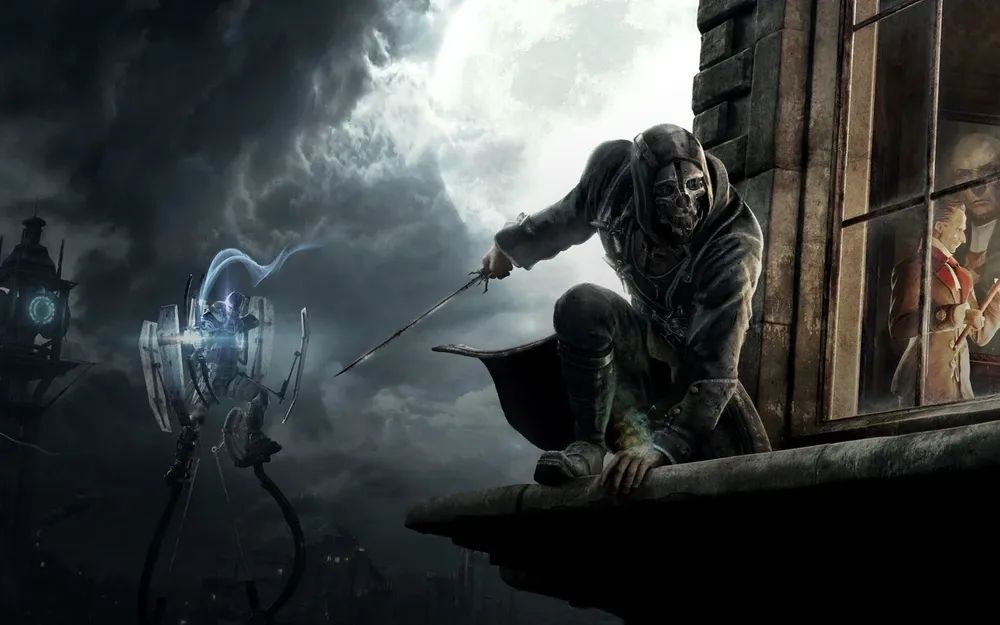
My first kill in Dishonored was a surprise.
I was sneaking my way through the collapsing buildings of Kaldwin's Bridge, careful to avoid the streets below where the City Watch was patrolling. I was on the hunt for Anton Sokolov, Royal Physician and Head of the Academy of Natural Philosophy. My instructions were clear: he was to be taken alive. This was no matter – I had dispatched each of my targets by non-lethal means.
I leapt from the top of one building through a collapsed roof, down into an abandoned living room – just as a member of the City Watch entered from the hallway. He unsheathed and swung his blade at me – without thinking, I parried and slashed back with my own.
And just like that, in an instant, my no-kill playthrough of Dishonored was over.
I stood frozen for a few seconds, weighing my next moves. Sure, I could reload a previous save – Dishonored is incredibly generous with auto-saves, and I would only lose about two minutes of progress. I could go back and act like it never happened, my clean record intact. I had done that many times already.
But there was something in how it all happened that kept me from reloading my previous save. Corvo Attano, the player character, is the most wanted man in the entire city of Dunwall. His likeness is plastered on posters all over; his name is broadcast over the loudspeakers day and night. And instead of hiding out, safe in the attic of Hound Pits Pub, Corvo must weave through the city to reach his targets.
It was only a matter of time before some unfortunate guard got the drop on him, and Corvo – armed to the teeth with a knife, pistol, crossbow, grenades, and razorwire – would need to act quick. The speed of it all, the reflex of it...
This felt like something that would happen, in-universe. It felt canonical, and it caused me to re-evaluate my approach to Dishonored.
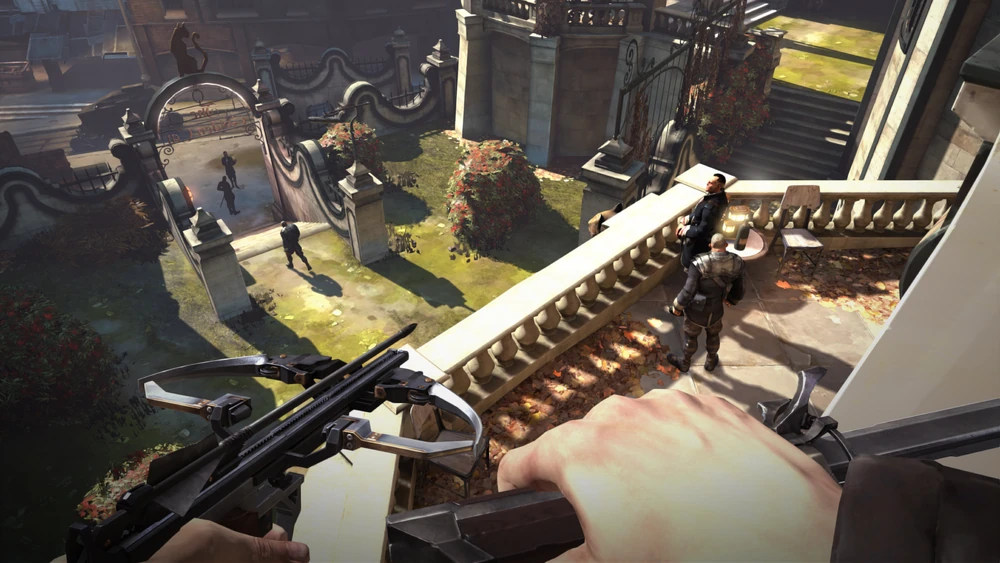
Released in 2012 by Arkane Studios, Dishonored is an immersive sim where you control an assassin tasked with eliminating key targets across labyrinthian, choice-driven levels. All of this is anchored by a morality system that tracks how you play: the Chaos system. There's Low Chaos, a primarily non-lethal approach where you utilize chokeholds, sleep darts, and alternative means to dispatch your targets; and High Chaos, where you leverage the full suite of Corvo's arsenal to kill as many of your enemies as possible.
It was very common for games of this era to have morality systems that push you into binary states of good versus evil, and reward you for being consistent in the path you choose. They were rarely very deep: most of the time, when presented with a moral decision, it was painfully obvious which was the good option, and which was the evil option.
Do you give food to the poor, or keep it for yourself?
These situations were more about the impact to gameplay than they were about forcing you to dig into your ideals. Evil options tend to give more destructive powers and better resources, whereas good options cause you to forfeit these boons for the price of being a good person. Many games even color-coded their decisions red and blue.
This wasn't a huge issue in-and-of-itself, but the problem arose in how these games would ask you to commit, where you're incentivized to be good or evil for the entirety of your playthrough, in every situation, as the reward structures were built around consistency.
For example, in the Mass Effect trilogy, players are rewarded for either being full Paragon (good) or Renegade (evil) by unlocking new dialogue choices or scenarios. If you're enough of a Paragon in Mass Effect 1, you can save Wrex. If you're enough of a Renegade in Mass Effect 2, you can choose Morinth over Samara. Players who choose the middle path, who make their morality decisions in the moment, are at a disadvantage because they won't have enough points in either direction to unlock these more interesting scenarios. You're incentivized to always be good, or always be evil.
In inFAMOUS, most powers and abilities are locked behind the morality system. Good Karma results in powers that are more precise and focused; Evil Karma unlocks powers that are more destructive. Players who choose the middle-of-the-road, who don't fully commit morality-wise to one path, are mechanically weaker.
In BioShock, the player will come across genetically-modified children called Little Sisters that you must either save, or harvest. Saving the Little Sisters will cure the child, but net the player a lesser reward, whereas harvesting will net the full reward, but at the cost of killing the Little Sister. This is perhaps the most binary of morality systems, as harvesting is never justified as anything other than a desire for power, and even though there are technically three endings – save all, harvest some, or harvest all – the latter two are the same script with a minor shift in tone.
Modern games have developed a much more nuanced view of handling choice, with games like The Witcher 3 and Disco Elysium eschewing binary good-versus-evil for more situational conundrums, where right or wrong is influenced by the ideals of the player, not the game. However, in the previous era, the message was clear: players who commit to being all good or all evil will get the best powers, the most interesting dialogue, the more impactful endings. Players who decide based on the situation get a worse version of everything.

Dishonored never says you must choose one of its two primary playstyles – it gives you the freedom and tools to play how you want. You can go on a full rampage in one mission, tallying up a high body count, and sneak past everyone in the next. Unlike its peers, Dishonored actually allows for more situational decision-making.
The mechanics of the morality system are pretty simple. You start the game at Low Chaos, and with each kill, or decision that would result in death, the Chaos meter increases. Cause enough Chaos, and you receive the evil ending. This is already a more interesting approach: instead of a moral fork-in-the-road like Mass Effect, where going down one path strays you further from the other, Dishonored is a running tally in one direction. If your goal is Low, you have a bit of a buffer before crossing the threshold into High.
This is valuable in a game where the non-lethal approach isn't always the lesser evil. If you spare the Pendleton Twins, for example, they will be expelled to the mines with their tongues cut out. Sparing Lady Boyle means giving her over to an obsessive kidnapper. If Dishonored were to execute its morality system like Mass Effect, then you would be incentivized to always spare, or always kill, because down the line, you would be rewarded for your commitment. But because you have a bit of moral leeway, you can, to an extent, make a game-time decision that breaks from your previous inclinations.
Gameplay tends to reinforce this. Certain powers, like Bend Time and Dark Vision, are useful no matter the playstyle, but others like Devouring Swarm, Shadow Kill and Blood Thirsty are specifically geared towards High Chaos, with minimal to no value for a Low Chaos player. The difference is that your Chaos level bears no impact on what powers are available to you as a player. There are no morality-based skill trees that lock you into its path. If you're bored by the Low Chaos playstyle, buy Devouring Swarm and run wild.
When I started my first playthrough of Dishonored (I know, I'm late to the party), I immediately went to the forums to see which playstyle I should choose. I've been conditioned to believe that any game with a binary morality system needs to be played a certain way – hopping between Good and Evil Karma in inFAMOUS is the wrong way to play – and I wanted to make sure I had the best experience available, and avoid locking myself out of the most interesting content. The playerbase is largely split between Low and High Chaos, so I went with Low. For most games, I'm usually in the blue.
For the first few missions, I was a ghost, with the only remnants of my very existence being the occasional knocked-out guard. I made full use of the non-lethal arsenal, blinking to rooftops to avoid combat, slowing time to sneak past a guard into a different room, throwing bottles to distract. My scorecard at the end of each level was proof, showing zero hostiles and civilians killed.
And with Dishonored's generous save system, this was easy. As long as you're not in active combat, you can save wherever, whenever. Approaching a room with multiple guards? Save. If you get caught, reload and try again. Want to see the impact of a different dialogue choice? Save. Want to try out a new weapon without impacting your flawless record? Save, kill, reload, sneak past.
Because what's most important is playing it right – right? It's a lesser experience if you get a weak ending. It's a lesser experience if you hit a dialogue check and see two grayed out options available only to the most moral extremists. So I game'd the game to preserve the experience.
And then I got spotted in the crumbling house, and I killed a guard. Instead of reloading a save, I rolled with it. It turns out, there's a third way to play Dishonored.

One of the most important aspects of any game for me is immersion. I like a good story, an interesting protagonist, a fleshed-out world – anything that makes me forget I'm playing a video game.
In Dishonored, you play as Corvo Attano, Royal Protector to the Empress — a bodyguard of the highest rank. You don't learn much about Corvo's backstory, but through interactions with other characters, you learn that he is held in high esteem by the Empress, beloved by her daughter Emily, and when he is framed for the Empress' murder, many of his peers express doubt that he could've done it. At the same time, his rank means he is a highly-skilled combatant, capable of taking a life when the need arises.
The point is, you don't get to Corvo's canonical status by being a pacifist or a murderous psychopath. People aren't usually absolute reflections of good or evil, existing at the fringes, and there was nothing to indicate Corvo was, either. Most likely, he achieved his rank through a mix of cunning, bravery, self-determination, and skill – four attributes that can flip between good and bad depending on the situation.
I had lost the enjoyment of Dishonored when I reduced Corvo to a gameplay vehicle — something I could reload ad nauseum until the credits rolled and the pacifist achievement popped. It broke the immersion, and was a constant reminder that I playing a video game. None of this is real, who cares, take your clean record and move on.
I had lost the fun, so after killing that first guard, I chose to play Corvo in the way that I saw him – someone who exists in the gray, whose ideals and allegiances are fluid to current events. I accepted the killing as something that would happen in Corvo's quest for vengeance – with the amount of enemies he crosses path with, he would, inevitably, need to resort to that level of violence to stay on mission. This is the canon that I chose to believe, and I started acting in ways that made him the most believable. I kept a non-lethal, stealth-first approach, but stopped reloading saves and started making choices based on the situation.
I rarely got spotted, but when I did, I rolled with it, fleeing when I could, and standing my ground when I couldn't. I judged my targets based on what I thought they deserved. I chose to kill the Royal Interrogator: deep in his dungeon, he represented an absolute evil, and this felt like a necessary measure of justice that Corvo would agree with. I spared the Lord Regent, broadcasting his crimes to the city, stripping him of both status and power. Later, in the Flooded District, I came across High Overseer Campbell, who I had exiled earlier in the game by branding him with the Heretic's Mark. Delirious and broken by the plague, stumbling around in a zombie-like state, I felt my non-lethal decision that sent him there had been far crueler than a quick death. Taking pity on him, I had Corvo deal the killing blow – something I should've done from the start.
These actions kept me well within the bounds of Low Chaos, but they were decisions I felt Corvo would make. I started to enjoy the game more than I had, having freed myself from the shackles of binary morality. So what if I received a lesser ending? I would've enjoyed the actual game far more, and I believed that Corvo was still inherently good, his soul intact.
This almost changed after the betrayal.
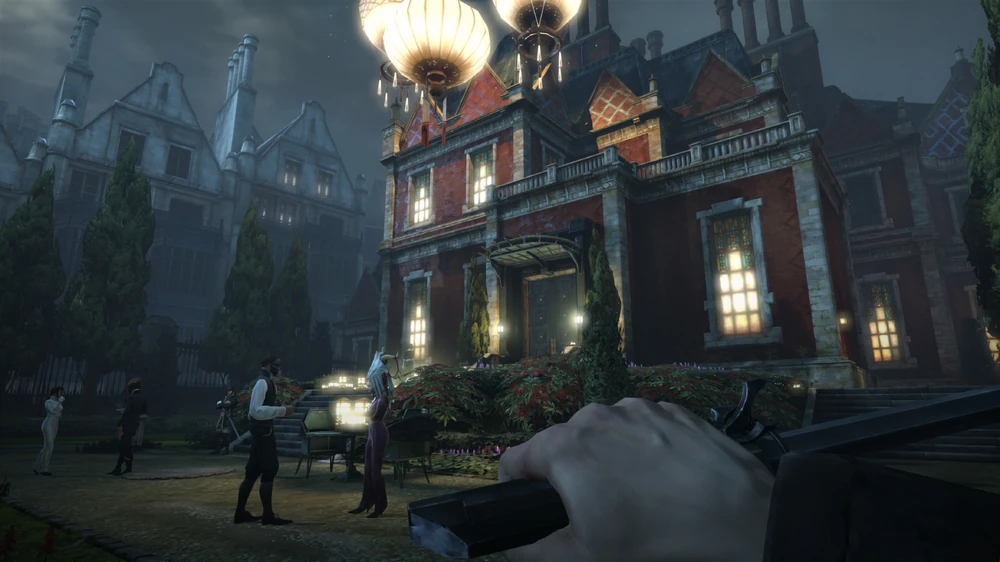
For most of Dishonored, you work for the Loyalists, a group intent on returning Emily to the throne. After dispatching the Lord Regent, the Loyalists — now with a clear path to the throne — decide to poison you and uphold you as the Empress' assassin. You survive, and after a long journey through the Flooded District, you return to the Loyalist headquarters to find it swarming with city guard.
At this point in the game, you'd failed in your duties as Royal Protector; been imprisoned for months in Coldridge Prison; eliminated key targets across Dunwall to find Emily and clear your name; and now, you've been betrayed by the very people who's dirty work you handled. It's justifiable that Corvo, very powerful at this point in the story and armed with a full suite of weapons and powers, would seek to handle things quickly and appropriately. And here I was, with a pistol I'd never fired, grenades I'd never thrown, razorwire I'd never placed, bolts I'd never shot.
"Alright, Corvo," I said, "let's have fun."
I tossed a grenade into three guards standing at the entrance and froze time. With eight seconds on the clock, I rushed two more guards and fired my pistol point-blank — the bullets hovered in front of their faces, waiting. I then leapt onto a patrolling Tall Boy and stabbed the driver. When time resumed, the grenade detonated, the bullets hit, and the Tall Boy collapsed into a heap of metal.
I blinked across the yard and took down another Tall Boy before getting rushed by more guards. I shot one assailant, parried and stabbed the next, and with a single guard remaining, I froze time again, circled around, and shot from behind.
It was only a few seconds, but it was a rush. Using weapons and powers in synergy, flying across the level in a dance of death, made me realize why people say High Chaos is so fun.
And it was enough (at least for this playthrough). Corvo had sent a message to the people that betrayed him, showing just what he was capable of. The rampage was over, and I put the weapons away. Thanks to how clean my play had been up to this point, I remained within the realm of Low Chaos.

Growing up in the era of Mass Effect, inFAMOUS and BioShock, it's difficult to sometimes ride the middle line. We've been conditioned to believe that video games force you onto a set morality path – and to be clear, that's true for these titles – but ultimately, the experience is your own. No matter how many rewards you might miss, or systems that push back, or forums that say you must play this way, the decisions are ultimately your own. With limited time to replay games, this can be a tough pill to swallow. You might never see the other path, and that's okay.
Bucking my usual tradition, for Dishonored, I chose the immersive path. The Interrogator deserved what he got. Campbell deserved a merciful death. The Loyalists deserved the rampage, and then they deserved for it to end. My ending slate wasn't the cleanest, and my scorecard wasn't perfect.
But this is largely a symptom of a previous era. More and more games are starting to reward the middle line, with morality systems that truly cause the player to stop and think, and branching narratives that will react to a player who changes their mind. These games aren't coded in red and blue; they don't tell you what's right or wrong.
They let you choose that for yourself.