A Playdate For My Son
Step aside, Mario. There's a new king in town.
As both a father and a gamer, I've long wondered what my son's first video game would be. What will he gravitate towards? Who will really capture his imagination?
And like a father who gives their infant a hockey stick in the hopes that it will manifest a journey to the NHL, I've been planting seeds since day one. The world map in his room is not our world – it's Azeroth, from World of Warcraft. His Fisher-Price playset is Mario themed, and he can name all the characters. I let him hold my controllers whenever he wants, to start building his muscle memory early.
But for all my planning and planting, the most unlikely of participants emerged.
As part of my MBA program at the University of Southern California, I wrote a marketing analysis on Panic's Playdate – a bright yellow handheld that anyone can develop games for, with a 1-bit screen, a modest processor, a d-pad, two buttons, and a crank. My thesis was that Playdate's focus on handcrafted indie titles was a breath of fresh air in a AAA market consumed by $80 price tags, predatory monetization, broken and buggy releases, and FOMO-engineered titles. I became so enamored with the device that I bought one.
Fast forward a couple months, and when my son wants to play a video game, he doesn't ask for Mario. Or Sonic. Or Pikachu.
He wants the Playdate. More specifically, he asks for...

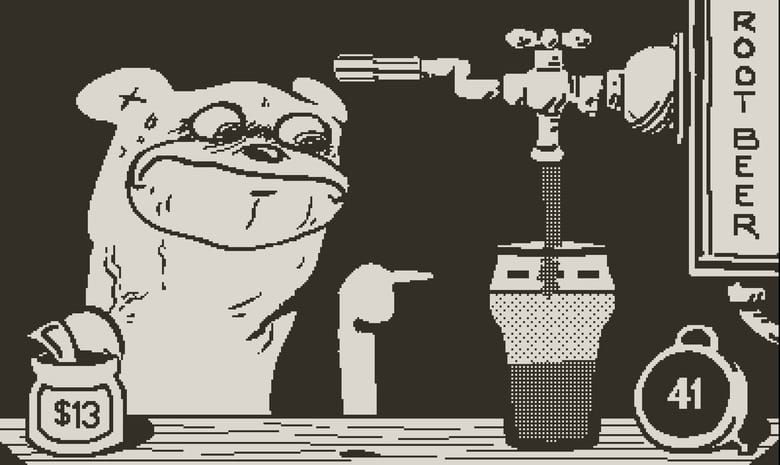
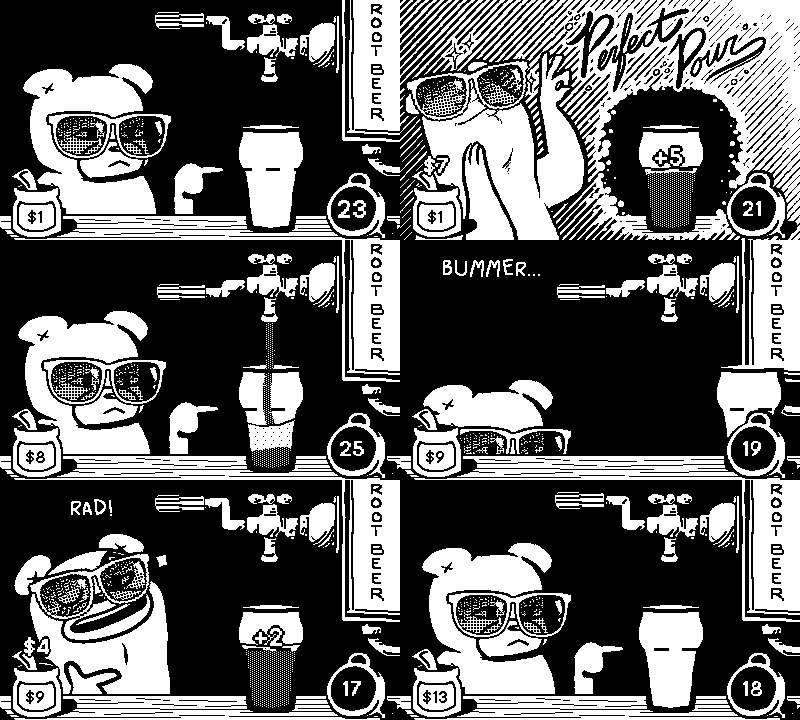
Nestled deep in the Playdate store is a little $3 game called Root Bear. The game is simple: turn the crank to fill a glass with root beer while a cute bear watches you... very intently. The closer you are to the line, the more tips you get. Fill the glass exactly to the line and you get a Perfect Pour. Overflow the glass and the bear has a full-on meltdown – complete with a Wilhelm scream that my child loves to imitate. It's cute. It's funny. It's low-stimulation. Overall, it's good game design.
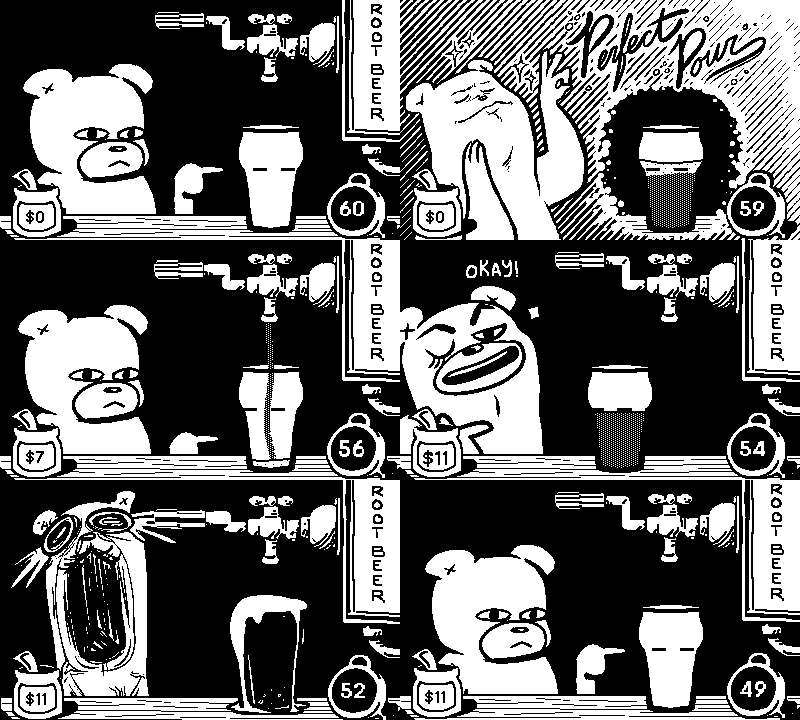
The best part about Root Bear is that it's a single-objective game. You have one goal: turn the crank to fill the glass. It never compounds into something more complex, never becomes something different than the first time you play it. At the end of the 60-second round, the game is done.
Most of my child's toys operate in a similar fashion. If he puts the square shape in the square hole, he wins. If he puts the ball in the hoop, he wins. There are no pre-requisites. The circle shape doesn't need to follow the square. There are no rules about his distance from the hoop. Anything extra is purely imagination added onto a toy that asks of him only one thing.
The simple gameplay loop of Root Bear, combined with the Playdate's tactile crank, make it feel closer to one of his toys than one of dad's video games. I might be aware that there's a score and a leaderboard, and I might be gunning to break the 100-point threshold, but he's not.
He just wants to make the bear happy. He loves the bear. If he sees the Playdate (the bright yellow makes it hard to miss) he will say "Root Bear!" in an adorable voice that makes it impossible for me to say no.
And then he'll pull out the crank and play a round – somewhat – correctly. Root Bear's presentation and loop are minimal enough for him to – mostly – know how.
When we think of games made for children today, the Playdate rarely comes up in conversation. It makes sense – it's a niche handheld, targeted primarily at collectors and hobbyists, that favors short, inventive, bite-sized experiences.
It's a tough value proposition against something like Roblox, which, on the surface, appears perfectly tailored to children. It's a creative sandbox hosting tens of millions of user-generated experiences – obstacle courses, fashion simulators, battle arenas, farming worlds, you name it – that anyone can join freely. Each day, there are new creations in the sandbox to discover and play, and therein lies my issue with it – it's endless. When your kid gets bored with whatever they're playing, or something gets too difficult, they can hit a few buttons and be in an entirely different game within seconds. It's essentially video game doomscrolling. The hook of Roblox is not any individual game; it's that Roblox is all games, all the time, whenever you want them.
To my son, the Playdate is a Root Bear machine. There's a marketplace on the device (that's where Root Bear came from), but he doesn't know it exists. We can stay focused on one game, one objective, until we've tapped its full potential, and only then will we discover something else. There's no refresh button he can hit to land in a new experience on his own time. He can't change the channel.
When we do move on, though, we'll stay in the Playdate ecosystem, which has a library of games that, like Root Bear, are handcrafted and smaller in scope, with low stimulation (owing to that 1-bit screen) and no predatory monetization. Not all of them are bangers, but there's very little violence and a lot of cute and endearing characters. It's a great playground for any child to find their gaming legs.
When I watch my son latch onto a single game, I find myself drawn to a similar boundary.
I grew up on games like Star Fox 64, which you could beat in under an hour if you knew what you were doing, but one that was highly replayable. Games were expensive back then, and the Nintendo 64 had no online marketplace, no downloads – you had what you had until you were given something new, so you cherished it. That's why I remember Star Fox 64 so clearly. When I beat it, I started it again, and again, until it was written into my memory.
I'm an adult now, with more money than I had when I was five, and more access to whatever video games I want. New games release constantly, go on sale constantly, and keeping up is nearly impossible. Most of us are sitting on backlogs we'll never clear, and buy games faster than we finish them. I might love what I'm playing, but often some new release will distract me and I move on.
In the time it's taken me to buy three AAA titles I still haven't finished, my son has fallen in love with one game, and he's enjoyed his one game far more than I have my three.
How much more would we appreciate the games we have if we, like him, viewed the world one game at a time?
Root Bear is one of those rare titles that I wish I made. When I watch him play it, I ask myself, "why didn't I make this?"
But it's deceptive craftsmanship. It tricks you into thinking anyone could've made it, before you realize that every decision is finely tuned to genuinely impressive degree. The bear's expressions are wonderfully ridiculous. The way the froth keeps you guessing on your pour provides just the right amount of challenge. The music provides the perfect mood.
Root Bear is just good, focused game design: easy to pick up, with an endearing mascot and a clearly communicated goal. That's why my son loves it, and honestly, I want him to be drawn to games like this. I don't want him chasing an everything game, or an endless game.
I want him to recognize when something is well-made. And Root Bear is just that.
Team Root, if you're reading this, my son would like to meet you.